


Let’s get this out of the way: we use AI. We’re not sitting here defending rapidograph pens and tracing paper like it’s 1987—we were only 5 and 7, respectively. AI’s a good tool for getting somewhere faster. It’s a starting point, a loose thread. It’s a hundred bad ideas in the time it used to take to get to the kernel of ONE good one.
That’s all fine. But letting it be the last set of eyes before something goes up. Or the last and only set of eyes before it goes to your designer to prep for print—as if they could—that’s a pro-ble-mo.
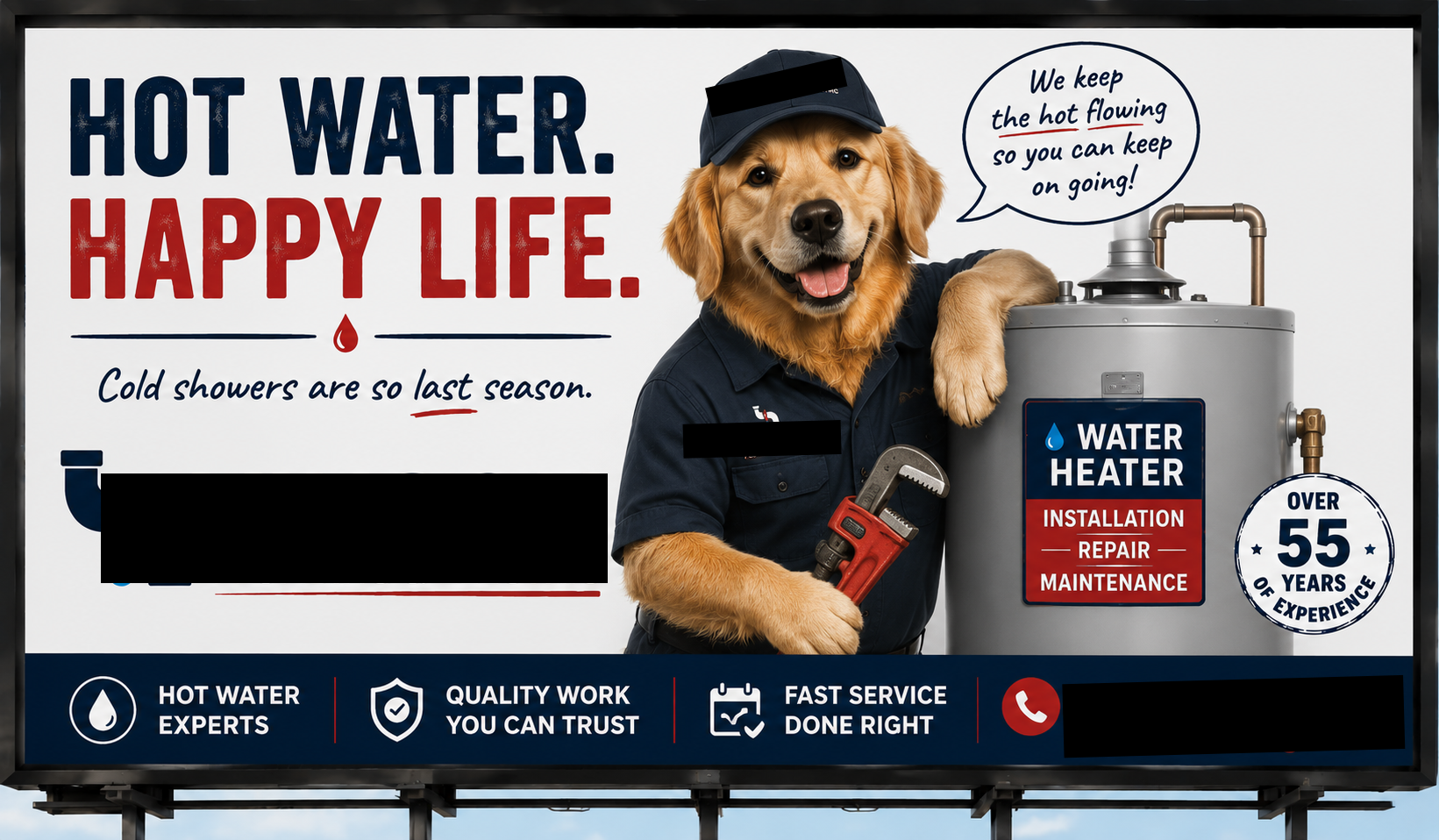
That’s not us being precious about craft. It’s math. A bad Instagram ad gets scrolled past in half a second and forgotten. A bad billboard sits there. Strapped down. Lit up. Impossible to skip, mute, or close out of. Every single person who drives that stretch of road sees it, every day, for the length of the contract—whether it’s good, bad, or an AI fever dream with six fingers on a golden retriever. Get it wrong and you don’t get a quiet failure. You get a landmark for all the wrong reasons.
Our job is subtraction. AI only knows how to add.
A good billboard design is violent. Five, maybe seven words, max. One idea. One place for the eye to go, and everything else gets murdered in editing. That’s the craft—cutting until there’s nothing left to cut. It’s brutal.
AI does the opposite by default. Sh*t, we’ve even asked AI to critique one of its own ads—the very ad you’re seeing up above. It found multiple flaws. When we asked it why it had given us this option at all, it came back with this, “It was that I didn’t edit myself hard enough before presenting it as a finished design. I leaned too heavily on familiar category tropes.” But more on that in another article.
AI is built to fill a frame and impress you on a screen, not survive a glance from a moving car. Left unsupervised, it hands you back something busy, overwritten, and dead on arrival the second you blow it up to board size. Somebody has to fight that instinct on purpose. The machine isn’t going to do it for you. Restraint isn’t really its thing. Sure, you could teach it, but you’d have to know enough to do that.
AI doesn’t live in our world.
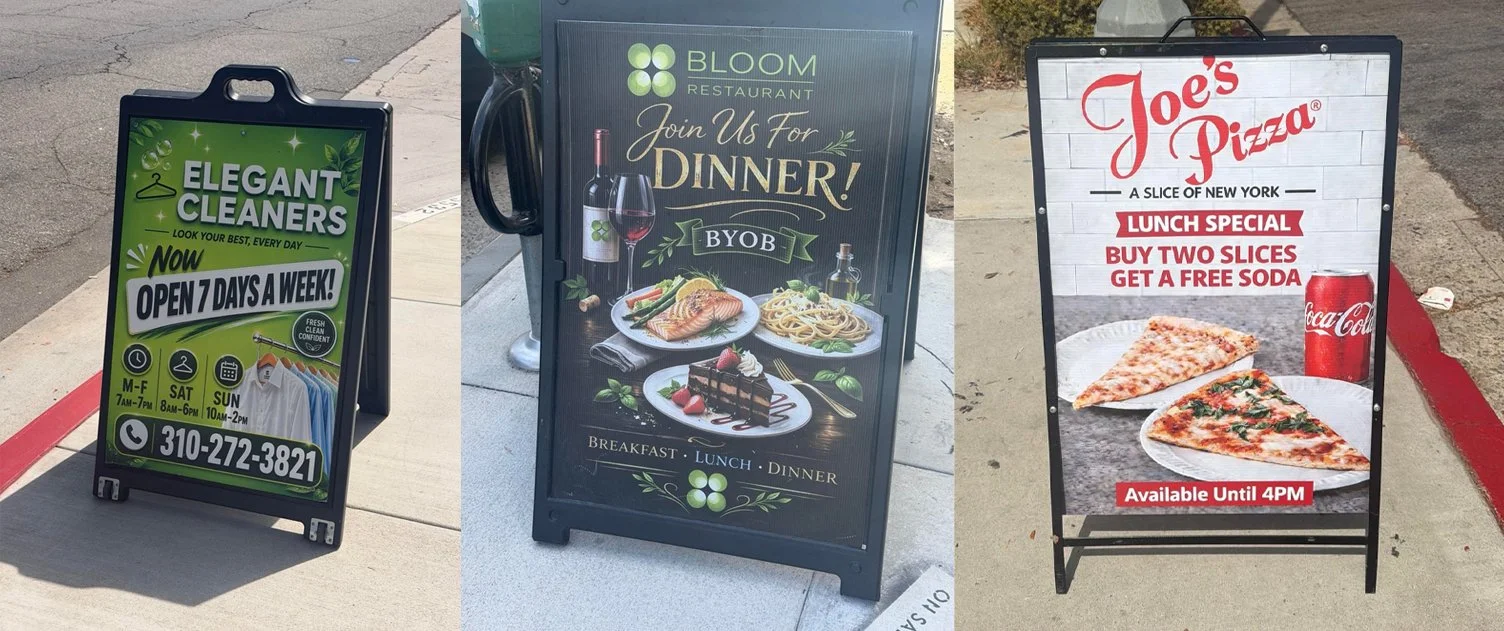
Here’s the thing nobody building these tools has ever had to think about: AI doesn’t know where the board is going. It doesn’t know if it’s a bulletin on the interstate getting read at 65 miles an hour, or a poster at eye level outside a coffee shop. It doesn’t know the sun sets directly behind it at 6pm, or that a maple tree eats the bottom third of it every summer, or that it’s got three other boards fighting for the same half-second of somebody’s attention.
Every real decision in this business—type size, contrast, how many words you get, where the eye lands first—comes from standing in front of the actual site, or at minimum looking at real photos of it. That’s not a nice-to-have. That’s the entire job. A model trained on a billion pretty pictures has no idea what “legible at highway speed” even means. Somebody who’s done this for a living does.
Your audience can sniff unfiltered AI sh*t a mile away.
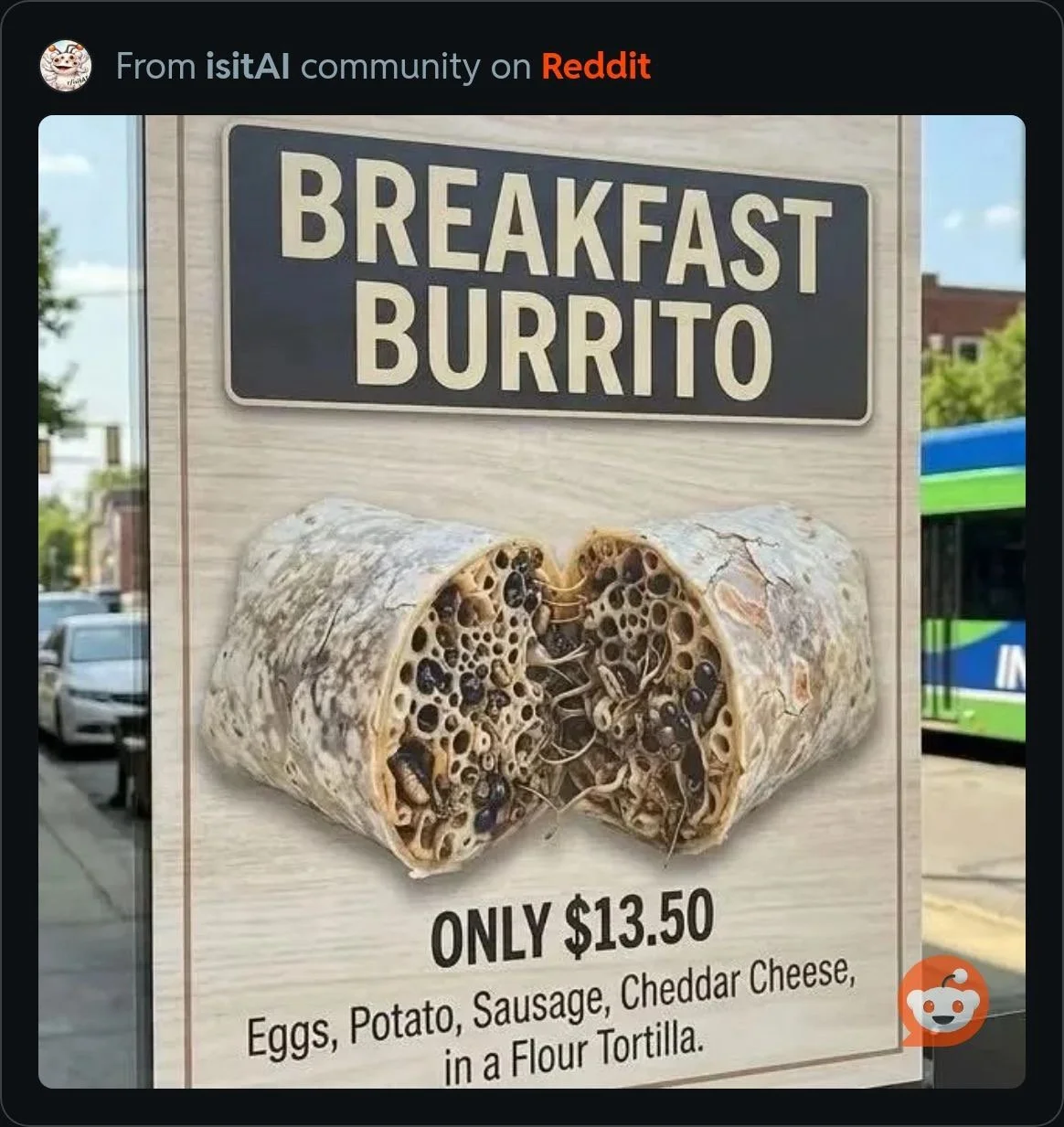
People are already primed to spot this and hate it. Sentiment on AI-generated advertising is running solidly negative, not neutral, in survey after survey. And that cuts deeper for billboards than almost anywhere else, because billboards are so damn visible. If it reads as generic, off-brand, or just wrong, that doesn’t quietly disappear. It becomes the thing people screenshot and talk about—while it’s still up, still yours, and still working against you.
Billboard companies: you’re already holding the keys.
Here’s the part that’s easy to miss, and it’s the whole reason this is a bigger deal for OOH than for anybody running a Facebook feed: you already have a checkpoint most channels don’t. Nothing gets printed and installed without going through reigorous production first—file specs, bleed, legal disclaimers. That gate already exists.
Which means you’re not just in a position to suggest human eyes on AI creative. You’re in a position to require it, the same way you already require a correctly sized file. It costs you nothing operationally—the review step is already there. It just has to start looking at hierarchy and legibility, not only pixel dimensions.
What that looks like in practice:
A design-review gate, separate from the spec check, that flags legibility, hierarchy, and maaaybe even human features that resemble human features.
A stated policy, in writing: AI-assisted is welcome. AI-generated-that-nobody-looked-at DOES NOT GO TO PRINT.
Account teams with actual authority to bounce a design back the same way they already would for a broken file. Push back before you hand it to your designers to “recreate.” It’s nearly impossible to get close to what AI typically provides as a flat, low-res file. Your designer will spend triple the time trying. Along those same line, don’t you lead the creative conversation with your own AI creative either—you’re setting unrealistic and problematic expectations with the client.
And to the brands: treat AI like a first draft, not a final one. Somebody who’s actually done this work needs to be the last person to touch it—hell, the first person—they need to see it waaay before it’s seeing the light of day. Save yourself the headache and disappointment and work alongside your billboard company’s account and creative team before you ever hit enter on the first prompt. If your local billboard company doesn’t have a creative on staff, find a trusty freelancer who knows better.
Until AI can walk into a room and think laterally.
None of this is an argument against the tool. It’s an argument against cutting the person out of the loop. Hierarchy, restraint, knowing what to cut, knowing how a specific board reads from a specific road—that’s still a human call, every single time. It’s also completely teachable. It doesn’t take a design degree, just the right foundation, sticking to your guns and keeping a sharp eye.
What it takes is somebody actually in the room. Right now, AI still isn’t that somebody. Until it is: keep the gatekeeper. Non-negotiable.
Did we get you thinkin’ laterally?
We’re Up To Something—a two-man OOH creative shop that builds emotionally charged billboard experiences for businesses of all sizes. If you’ve got something to say, stop handing it off blindly to AI, there’s another way. Less prompts, let’s talk.
To receive a free morning newsletter with each day’s Billboard insider articles email info@billboardinsider.com with the word “Subscribe” in the title. Our newsletter is free and we don’t sell our subscriber list.
Paid Advertisement