



LA Rams Owner Stan Kroenke is suing the city of Inglewood $400 million for failing to live up to a development agreement surrounding Hollywood Park mixed used development project which includes SoFi Stadium and Youtube Theater. The cause of the dispute was a 2025 deal that Inglewood signed with WOW Media to install up to 60 digital billboards around Hollywood Park. Kroenke is concerned that the new digital billboards will cut his revenues from sponsorships and on-site advertising at Hollywood Park. Here’s a history of the dispute.
- In 2009 Pincay RE, LLC. (“Pincay”) a company controlled by Kroenke and the city of Inglewood signed a development agreement for the Hollywood Park project (“Hollywood Park”). The agreement was amended and restated in 2015.
- In November 2015 Inglewood entered into a Billboard lease agreement with WOW Media, Inc. (“WOW”) to put 10 billboards in the city. None of the billboards were near Hollywood Park.
- In April 2025 Inglewood approved an exclusive agreement (“Billboard Agreement”) with WOW to put up to 60 digital signs and 108 digital screens at specific locations surrounding the Hollywood Park. The agreement will run for up to 40 years and requires WOW to pay the city 40% of gross revenue and to give the city up to 10% of the advertising space on the signs.
- In July 2025 Pincay filed a legal challenge to the approval of the agreement and asked for a trial and a preliminary injunction prohibiting the erection of any WOW billboards until the case is decided.
 In July 2025 Los Angeles County Superior Court dismissed a preliminary injunction arguing: “Hollywood Park has not shown that irreparable harm will occur to it if the preliminary injunction is denied…Hollywood Park does not identify any deal or contract placed in an eminent risk from the billboard agreement. While Hollywood Parks declarants state that existing relationships with sponsors, advertisers and events “may be negatively impacted”, none of the declarations come from an actual sponsor her site a specific deal that is threatened by the Billboard Agreement.” The case is headed for trial.
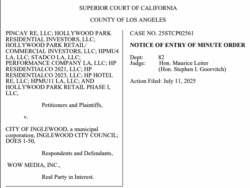
Billboard Insider’s take: Development agreements can create headaches especially if one development agreement impacts the ability of another development agreement to generate revenues. The Superior Court ruling makes interesting reading. Pincay raised multiple objections to the city’s billboard agreement (e.g. it surrenders police powers, it conflicts with the CA municipal code, it conflicts with the city charter, the billboards are a public safety risk and economic damage) but the court didn’t buy the preliminary arguments. Whether a jury will agree is another matter. In an interesting turn of events, the City of Inglewood now says that it doesn’t owe Kroenke any money because it has determined that it wasn’t authorized to sign the initial development agreement with Kroenke in the first place!
To receive a free morning newsletter with each day’s Billboard insider articles email info@billboardinsider.com with the word “Subscribe” in the title. Our newsletter is free and we don’t sell our subscriber list.








It’s ironic. Development Agreements in California are governed by a specific Article in the Government Code. The first Section of that Article declares that “The lack of certainty in the approval of development projects can result in a waste of resources … .”
Ten following Sections of the Government Code speak of the requirements and restrictions that apply to development agreements. I have not counted the number of the cases that interpret development agreements.
This is not our case, we had no part in the development agreement and I have not read the trial court’s decision. It is even possible that it will be reversed if appealed. At the same time, this case emphasizes the importance of paying attention to the details, including legislative requirements. Don’t let visions of a great deal blind you to the pedestrian, but necessary details.